
Fourteen year old Thomas Honor had been playing outside his house at Maroondan in Queensland’s Burnett region when he urgently beckoned his father. Walking to the back door David Honor, a widower, described seeing “a large aeroplane flying at a very low altitude Continue reading ““daddy come out and have a look at this funny plane””
Serial No. 1381, Bowen
The Australian Government had little expertise or interest in radar technology at the start of the Second World War. By 1942 however the continent’s coastline was dotted with scores of radar stations operated by locally-trained technicians using, in many instances, Australian-designed and built radar equipment. This is the story of one such unit – Bowen’s No.55 Radar Station (RAAF).
Built in anticipation of a possible Japanese aerial attack against Australian mainland targets, approval for development of the Bowen radar station (costing £9,700) was granted in early November 1942.1Encl. 27A, Air Force Headquarters – CAS [Chief of Air Staff] (Organisation) – Establishment – Radar Stations – General, NAA: Series A705, Control Symbol 231/9/1031, ID 3336324, https://recordsearch.naa.gov.au/SearchNRetrieve/NAAMedia/ShowImage.aspx?B=3336324&T=P&S=107. Land and buildings necessary for the development were then requisitioned via the National Security (General) Regulations). The site selected for the installation was an elevated sandstone plateau at Cape Edgecumbe, two miles north-east of the port. Continue reading “Serial No. 1381, Bowen”
9 September 1942
Bundaberg in south-eastern Queensland was a center for flying training during the Second World War. As a consequence, the surrounding Burnett Region is peppered with wartime crash sites.

A brick maker prior to enlisting, Flight Sergeant Thomas Peel Drury was one of many pilots who came to grief while undergoing advanced training at the RAAF’s No.8 Secondary Flying Training School (SFTS) in Bundaberg. Continue reading “9 September 1942”
Project 1381
Surrounded in every direction by sugar cane fields, the steel and concrete remnants atop Charlies Hill south of Home Hill (North Queensland) reveal little now of the anxieties that led to its construction, nor the secrecy that once surrounded the operations of this former wartime radar station. Continue reading “Project 1381”
That tabua
It is not generally known that the Queensland Museum holds the most comprehensive and important collection of Charles Kingsford-Smith memorabilia, none of which have seen the light of day since returning to Australia on 9th June 1975 (coinciding with the anniversary of the first Pacific flight).
Credit for securing this extraordinary collection comprising more than a hundred objects belongs to former Librarian Edward (Ted) Wixted who initially encouraged the aviator’s widow (Mrs AllanTully, and son, also Charles) to consider donating the collection to Queensland. As a consequence, the latter wrote to the state’s then Premier on 6th October 1974, expressing the view that ‘Charles and I agree they [CKS’s memorabilia] should be shared with the people of our homeland and properly displayed.’

In a follow-up letter to the Museum’s Director dated 14th March 1975, Charles (son) elaborated…’ You may not be aware that most of the documentation we have consists of several scrapbooks of newspaper clippings, and a large quantity of photographs. Unfortunately we don’t have any original correspondence or other such material of the nature that usually interests historians. The most important items of original documentation we do have are my father’s log books, covering approximately the years 1921-1932, and nautical charts he used with his courses plotted on them. We would consider giving these to the Museum as indefinite loan, if adequate copies could be made. The bulk of the collection of memorabilia we have consists of numerous awards, medals, trophies, etc.’
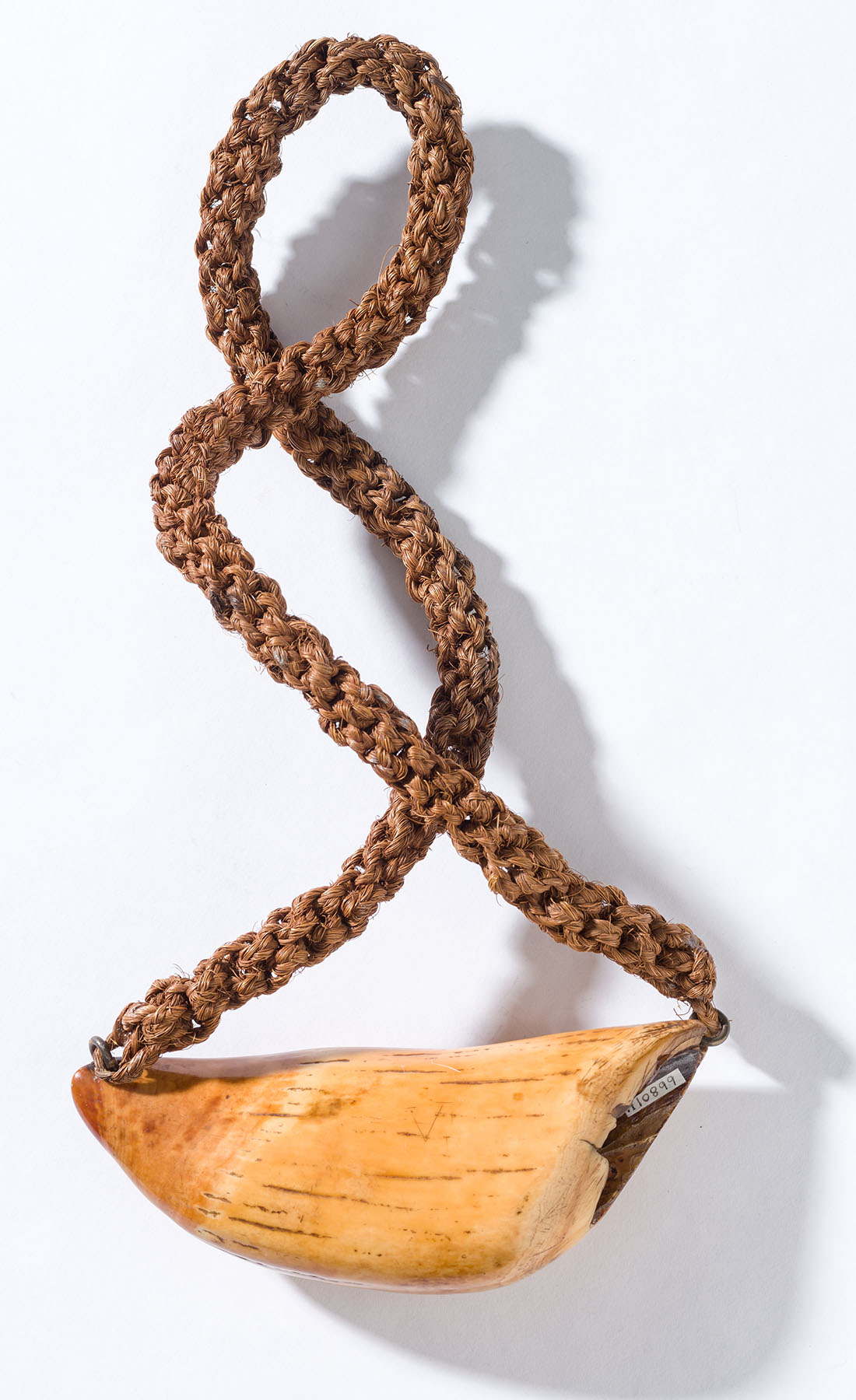
All but one of these items are of European manufacture and it is this exception which I find the most intriguing (because of its mysterious inscription). The crew of the Southern Cross had spent Wednesday, 6th June 1928 inspecting possible take-off sites for their final leg from Suva to Brisbane. That evening, a ball was held in their honor at the Grand Pacific Hotel…’A feature of the entertainment was the Fijian chiefs’ welcome. Rato Joni Mataitini, one of the leading chieftains, presented a whale’s tooth to Captain Smith. This is the greatest welcome ceremony that can be given by Fijians to high chiefs or officials.’1
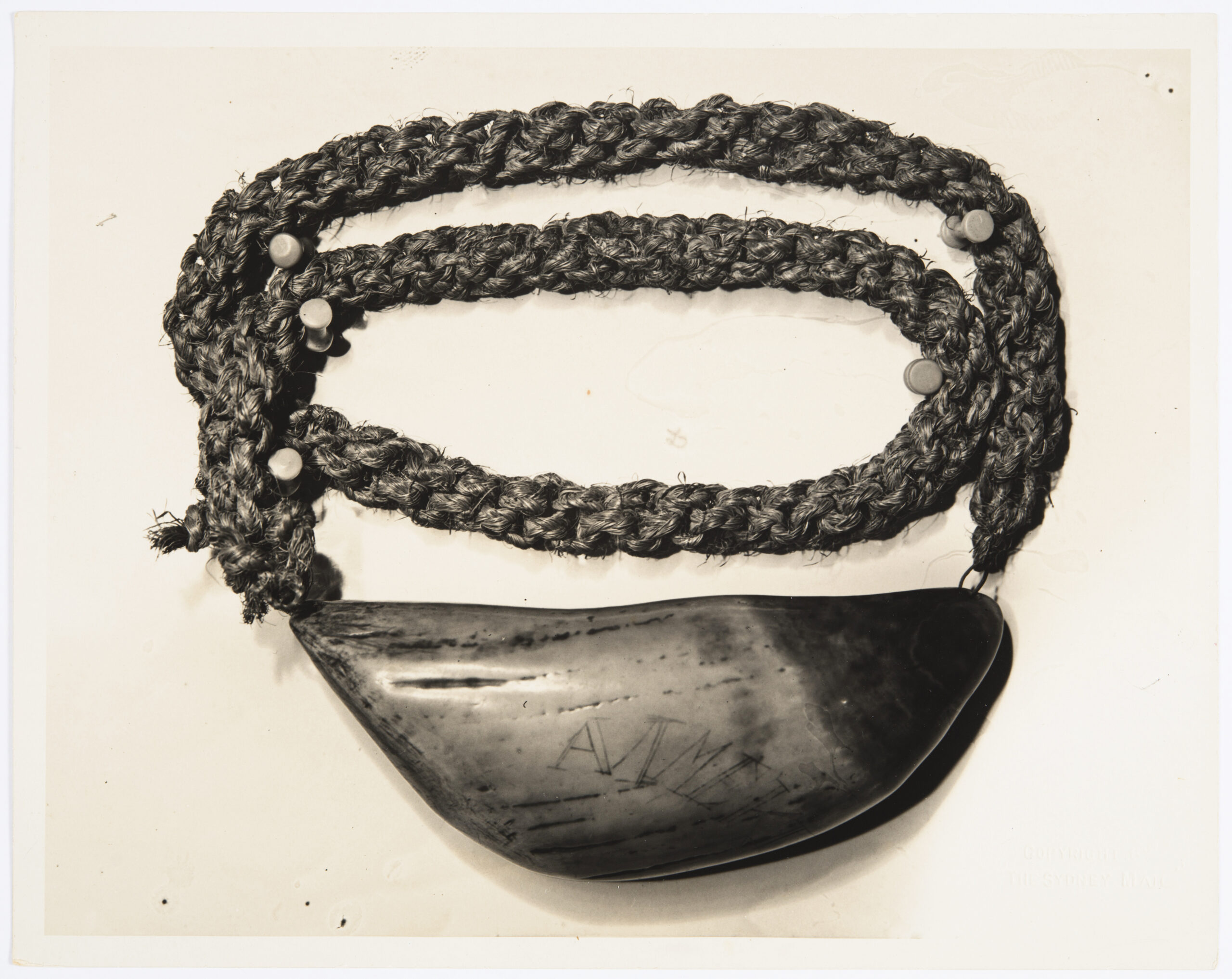
An important cultural item in Fijian society, these polished sperm whale teeth were known locally as tabua. They were traditionally given as gifts for atonement or esteem (called sevusevu), and were important in negotiations between rival chiefs. Originally they were very rare items, available only from beached whales and from trade from neighbouring Tonga (where the practice may have originated).
Sadly, the significance of this gesture was lost on at least one Australian newspaper which attempted, instead, to make light of the gift.2
Particularly intriguing in this instance is the inscription which has so far resisted all online attempts at translation. I put this problem to the Museum of Fiji some years ago which, much to my surprise, was also unable to offer a translation. Like so much in this remarkable collection, this object demands further research or, at the very least, as Lady Kingsford Smith stipulated in her original letter of offer, to be ‘shared with the people of our homeland and properly displayed.’

Footnotes
GAF Jindivik programme, August 1966


bin saves
I cannot be sure when or where it was exactly that I retrieved these, but I am guessing this might have been around 1995 during the Maribyrnong Munitions Factory or RAAF Laverton closures. Whichever, I simply couldn’t let these Kodachrome slides get carted off for land-fill.
Dumpster-diving isn’t taught to museum studies students, and is never likely to be. That’s a shame because museum employees are often – as happened in this instance – given privileged access to important sites before they’re irrevocably altered, or lost.
Here we have a uncommon glimpse of an era when state-of-the-art fighter aircraft were locally hand-crafted under the one roof by tradesmen employed on the basis of their skills, rather than their age. Continue reading “bin saves”
