
99183693707602061.
Publicly funded museums rank as some of our most trusted social institutions. Recent studies highlight that this trust is “largely based on the perception that museums are ‘fact-based’ and present ‘real/original/authentic objects’.”1 American Alliance of Museums, “Museums and Trust 2021,” American Alliance of Museums, 30 September 2021, https://www.aam-us.org/2021/09/30/museums-and-trust-2021/. Museum visitors expect to encounter materially and factually authentic objects in museums. Unsurprisingly, researchers have also found that “most museum visitors assume they are viewing a materially authentic or original object [simply] because the object is in a museum.” 2Jordan Kistler, “Facts and Fictions: Emotional Authenticity and Narrative in Natural History Exhibitions,” Museum & Society, March 2025. 23(1), 38; Constanze Hampp & Stephan Schwan, “The Role of Authentic
Objects in Museums of the History of Science and Technology: Findings from a
visitor study,” International Journal of Science Education, Part B, 5:2 (2015), 170, https://www.tandfonline.com/doi/full/10.1080/21548455.2013.875238.. But what if that isn’t the case? What if that object which thousands of pundits have travelled to see is actually a forgery, a replica, or something less than original? Will this somehow undermine the public’s unconditional trust, or diminish the museum’s social license? Will this cause lasting reputational damage and declining visitation or, will the consequences be negligible?
Mindful of these possibilities, history museums have been especially coy about addressing authenticity issues. Accessing collection information in history museums is notoriously difficult and, unlike their scientific colleagues, much of the research undertaken by history curators remains either inaccessible, unpublished, or shielded from independent external review. Three years ago however the Queensland Museum, in a move that was both surprising and unprecedented, bravely questioned the authenticity of its unique 1920 Avro Baby biplane, originally owned by Queenslander Bert Hinkler.3Peter Volk, “Avro Baby: Original or Museum Mock-Up?,” Queensland Museum, 29 June 2022, https://blog.qm.qld.gov.au/2022/06/29/avro-baby-original-or-museum-mock-up/. The Museum’s Assistant Collections Manager concluded then that aside from the fabric covering and possibly the wheels, “everything else is, as far as we can tell, as Bert left it.”4Peter Volk, “Avro Baby.”
This independent reassessment challenges those 2022 findings by suggesting, instead, that much of what remains of Hinkler’s Avro 534 either is, or appears to be, unoriginal. This derives from a detailed examination of the dismantled aircraft undertaken, for official valuation purposes, on 18 May 2012. The imagery and field notes taken on that occasion were subsequently analysed in conjunction with period imagery, together with archival documentary and grey literature sources. This analysis was conducted however without reference to the Civil Aviation Department file, Registration & Airworthiness – Avro Baby No1, held at the Melbourne repository of the National Archive.5National Archives of Australia (Melbourne): MP113/1, VH/UCQ, 333432. Modifications, repairs and accident details are typically recorded in such files.
Although authenticity is a culturally contingent term it is used interchangeably here, with original, to describe the material qualities of an object, “which should [then] be scientifically or historically verifiable.”6Kistler, 38. What follows are the summarized results of this informal reappraisal which are shared not as criticism – the museum having to work with what it inherited:
Engine
There is compelling documentary evidence to show that the aircraft’s original engine was removed and sold, prior to 1945, to a Mr. A. Natoli of Sydney. This claim was subsequently and independently corroborated by Bert Hinkler’s brother, George Hinkler.7“Bert Hinkler Memories,” Smith’s Weekly, 23 June 1945, 9, https://trove.nla.gov.au/newspaper/article/234641195 Further evidence supporting this last explanation has been found recently in the Australian Archives. The Civil Aviation Board had advised the aircraft’s owner in October 1936 that it was not prepared to renew the Baby’s Certificate of Registration.8 S. H. Crawford (CAB) to J. J. Smith, letter, 13 October 1936, Registration and airworthiness Avro Baby VH-UCQ, National Archives of Australia: MP113/1, VH/UCQ, 333432 This followed the Board’s March 1933 ruling that all Australian registered aircraft engines were thereafter required to have dual ignition. Since the Avro’s Green engine was fitted with a single ignition system it was essentially worthless, at least from an aviation standpoint.
Carburettor
The engine is currently fitted with a Zenith 36ABC carburettor, one online source claiming that these were fitted to the Green Type 64 engine.9Kimble D. McCutcheon, Selected Early Engines, revised 16 June 2022, https://www.enginehistory.org/Piston/Before1925/EarlyEngines/G/G.shtml
Propeller
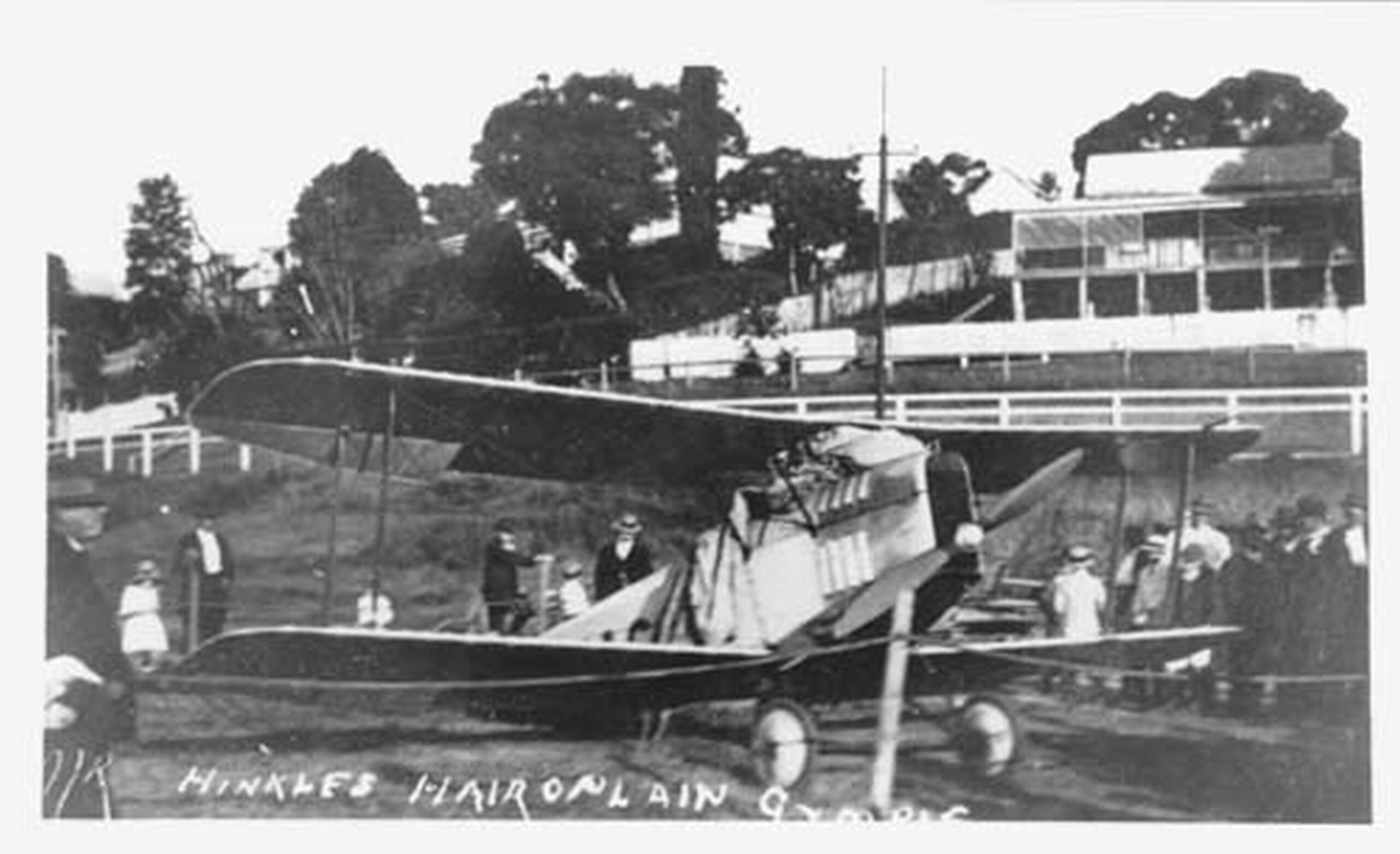
This is unlikely to be the original, the rudder and propeller having both been damaged when the aircraft overturned, north of Newcastle, on 21 April 1921.10“Aviation Mishap. Lieutenant Hinkler’s Trouble,” Newcastle Morning Herald, 30 April 1921, 6, https://trove.nla.gov.au/newspaper/article/140034565. Markings impressed into the propeller blades confirm, nonetheless, that it does date from the early 1920s and would have been an appropriate match for Hinkler’s Green C-4 engine. It is notable that the existing blade painting is also inconsistent with that shown in historical images (where the blade painting extends almost to the propellor hub). This could indicate that the propeller was stripped and inaccurately repainted during restoration, or earlier repair. Alternatively, the existing propellor could be a replacement, and not the one used by Hinkler in 1921.
Spinner
Historical imagery shows the aircraft fitted in 1921 with a bare metal propeller spinner. This was missing when title transferred to the Queensland Museum in 1970.
Magneto
The Museum’s aircraft is fitted with a BTH GA4-K3 magneto (No. 8D1005117). Since these were first introduced in the mid-1930s it cannot be an unoriginal installation. Its presence lends some further to the published evidence indicating that the engine is also unoriginal.
Pitot tube
Historical imagery shows the aircraft fitted with a single pitot tube. Presently however the Avro is fitted with an unoriginal twin-tube pitot.
Fasteners
Modern fasteners have been used extensively, in lieu of originals or period-appropriate equivalents. A variety of shapes and sizes can be found, including American nyloc nuts, cadmium plated engine mount bolts and worm-drive radiator hose clamps, castellated nuts and cotter pins, lock wiring and turnbuckles. It is presumed that these were fitted during the 1972 restoration as replacement for originals that were either missing, damaged, or degraded.
Fabrics
None of the aircraft’s fabric coverings are original. Modern fabrics have been used extensively and, here again, it is presumed that these were fitted during the 1972 restoration as substitutes for original fabrics that were either missing, damaged, or degraded. Original fabric specifications were not recorded prior to the restoration, and nor were any original samples retained, this approach being wholly consistent with the museum’s prevailing ethos which prioritized cosmetic appearance, and completeness, ahead of originality. Modern fabrics appear as fuselage and wing coverings, as felt rubbing strips (between the engine cowling and radiator), as bungee chords (undercarriage), and as synthetic cockpit coaming and lacings. Modern phenolic sheet can also be found within the engine bay.
Hoses
Modern radiator hosing, with knitted synthetic reinforcing has been used to connect the engine to both the radiator and oil tank (using modern worm-drive fasteners).
Paint
The Queensland Museum has nothing in its collection or files to indicate that the aircraft’s paint colours were informed either by documentary research or sample analysis. Indeed, there is nothing in the museum’s correspondence or object files suggesting any guidance or oversight throughout the restoration, completed by Air Charter Pty. Ltd at a cost of $2,200.11Hinkler’s Biplane, RAAF News 14, no.2, May 1972, 3, https://trove.nla.gov.au/newspaper/article/259477288 The hue, value and intensity of the existing (semi-gloss) white finish must, therefore, be regarded with suspicion, as should its method and extent of application (via spray gun), and chemical composition. It is clear from historical imagery that the aircraft’s cowlings were unpainted while the aircraft was being flown by Hinkler in Australia. These however were also painted white during the 1972 restoration.
Windshield
The existing windshield is unoriginal, its appearance altogether unlike the frameless, low-profile windshield originally fitted to Hinkler’s aircraft.
Instrumentation
None of the instruments currently installed are original, these appearing to all be of Second World War (or later) origin. Also missing is the large magnetic compass, one of the plane’s most prominent features – visible in most period photographs. There is no evidence either that the instrument panel was originally painted black, as is presently the case. Remnant screw holes and unfilled instrument apertures suggest however that the panel does pre-date the 1972 restoration.
Pilot’s seat
Further investigation is needed to determine if the pilot’s seat is original. Both wood and metal seats can be found on contemporaneous Avro designs such as the Avro 504. While the Shuttleworth’s modified Avro 504, for example, is fitted with an aluminium seat, the Australian War Memorial’s unmodified 504 has wooden seats.
Elevator control horns
Historical imagery confirms that the existing elevator control horns, both prominent fuselage features, are unoriginal, as are the connecting turnbuckles.
Undercarriage
The wheels and tyres are certainly unoriginal, both being wider than those photographed in 1921. The existing wheels also appear to be of smaller diameter than the originals. In 1921 fabric spoke covers were fitted to each wheel, on both the inside and outside. The latter are no longer fitted, and no valve access apertures have been included in those that remain.
The loss of original materials and fittings is hardly surprising, given the aircraft’s age, functional redesigns, and ownership changes. In all it has had five Australian owners; was repaired at least four times; had its fabric replaced at least twice; was converted from landplane to seaplane, then back to landplane again; was converted from a single seat to a tandem two-seat aircraft, then reconverted back to single seat; was damaged after overturning on a beach in 1921; and then completely restored at least twice.12Neville M. Parnell and Trevor Boughton, Flypast: a record of aviation in Australia (Canberra: AGPS, 1988), 44, https://archive.org/details/flypastrecordofa0000parn/page/44/mode/1up. While there can be no doubting its Avro 534 origins, it is misleading to claim or imply t̶hat this is an original aircraft. It would be more accurate – and honest – to say that this exhibit had been rebuilt using structural elements from Bert Hinkler’s original Avro Baby.
After you strip away those elements that are definitely and possibly unoriginal, such as the fabric, the wheels, the instruments, the engine, the seat, the windshield, the propeller, the coaming, and the myriad fasteners and hoses, all that remains is the internal wooden structure, the undercarriage tubing, the radiator, the fuel and oil tanks, and the cowling. Some wood in the upper fuselage of course will have also been replaced when the plane was converted from single to dual seats, then back to single seat configuration.13G-AUCQ Avro 534 Baby, edcoatescollection.com, http://www.edcoatescollection.com/ac1/austu/VH-UCQ.html. Nor is there much comfort to be had from putting aside the question of originality, and focusing only the aircraft’s cosmetic appearance. Almost every marking on the post-restoration aircraft is inaccurate in terms of its size, location, form or style.
Authenticity is important not only because of its influence on visitor perceptions. It also has direct bearing on the notion of significance used by heritage professionals to evaluate acquisition, disposal, storage, conservation, exhibition, research, insurance and funding priorities. If heritage significance was a function of an artefact’s weight only then the museum could still claim, with some authority, to possess the substantial remains of Hinkler’s Avro Baby aircraft. Significance assessment however utilizes a more complex equation that accounts for an object’s combined cultural, historical, technological, aesthetic, and spiritual values.
Understandably, museums are reluctant to expend resources when any, some, or all of these values are either diminished, or missing altogether. This partly explains why the Avro has remained in storage, and on loan for past decades. The Queensland Museum acquired the Avro Baby on the strength of its questionable technological and historical significances which were both heavily compromised long before the aircraft transferred to Brisbane, being further eroded during the 1972 restoration.14The Avro 534 was neither technically remarkable or commercially succesful. It is significant, too, that Hinkler had been in Australia for almost a week before the Avro’s arrival (and his) was reported, passingly, in an Australian newspaper, vide “Bringing home the Avro ‘Baby’,” The Bunbury Herald and Blackwood Express, 13 March 1928,3 While the prospect of deaccessioning appears unlikely, these latest findings do provide justification for maintaining the existing out-of-sight out-of-mind course — one that has already spared the museum considerable expense and effort.
Three years ago the Queensland Museum determined that the aircraft was “much as he [Hinkler] left it.” That much of what is left, isn’t “it,” is simply inconvenient.


